
Case studies — what a recovery actually takes
Four situations we handle repeatedly, described as they really run. Names, institutions and identifying details are removed, and the figures are typical rather than lifted from one student's gradebook. We would rather show you the shape of the work than invent a testimonial with a photograph attached.
On honesty in this section. These are composites drawn from recurring patterns across seven years, not transcripts of single engagements. We have anonymised them deliberately — students who use this service do not want their course, university and grade published, and any company showing you named, photographed, fully-identified academic clients is either making them up or has been careless with someone's privacy.
Case 1 — joined at 48%, finished with a B
The most common engagement we take, and the one people assume is impossible.
The situation
A student contacts us in week nine of a fifteen-week course. They believe they are at roughly 70% because that is what the dashboard says. They are not. The course runs on Canvas, the gradebook is set to its default running total, and four assignments have never been submitted — so they are not counted as zeros, they are simply not counted at all.
The first thing we do is untick "calculate based only on graded assignments". The real figure comes back at 48%. That conversation is unpleasant and it is the most valuable twenty minutes of the whole engagement, because every plan built on the 70% figure would have been the wrong plan.
The arithmetic
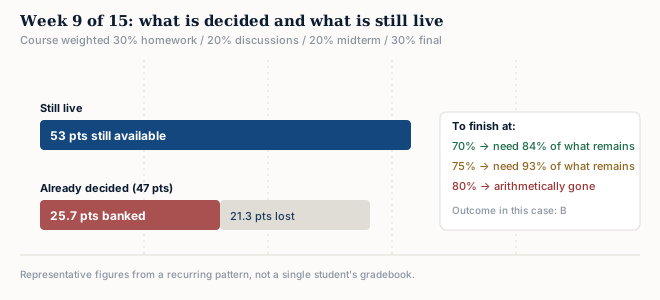
Course weighting: 30% homework, 20% discussions, 20% midterm, 30% final. Six weeks remain.
| Component | Weight | Position at week 9 | Points banked |
|---|---|---|---|
| Homework | 30 | Half graded, 4 missing | 9.5 of 15 available so far |
| Discussions | 20 | Initial posts done, replies missed | 4.0 of 12 |
| Midterm | 20 | Sat, scored 61% | 12.2 of 20 |
| Final | 30 | Not yet taken — proctored | 0 of 30 |
25.7 points banked out of the 47 already decided. 53 points still live. To finish at 80% they would need 54.3 of 53 — arithmetically gone. To finish at 70% they need 44.3 of 53, or 84% on everything remaining. Hard, and real.
What we did, and what they did
We took the remaining homework and the discussion requirement — the recurring volume that had been eating their weeks. Two of the four missed assignments were still open under a 10%-per-day late policy and worth recovering; two were behind a hard close and we told them to stop thinking about those. Writing off unrecoverable work is usually what makes the rest achievable.
The final was proctored. That was theirs, and it was 30% of the grade — which is precisely why the plan mattered. With six weeks of coursework carried, they had six weeks to prepare for one exam instead of six weeks of triage. They sat it and scored in the mid-seventies.
Outcome
Final grade: B. Not the A the dashboard had implied was within reach in week nine, and not the F that week nine actually pointed at.
The honest caveat. This works when there are four or more weeks left and the proctored share is not most of the grade. A student arriving in week fourteen with a cumulative proctored final worth 40% is in a different situation, and we say so rather than take the money.
Case 2 — a final paper in eight hours
These arrive at 11pm and they are survivable more often than people expect.
The situation
A student messages at around 10pm. A final paper — eight to ten pages, APA 7, minimum six peer-reviewed sources — is due at 8am. It has not been started. Not from laziness: two other finals in the same week, a job, and a course they had been quietly writing off until they saw the weighting.
What determines whether this is possible
Three things, established in the first ten minutes, before anyone agrees to anything:
- Is the prompt specific enough to write against? A clear prompt with a rubric is workable. "Write about a topic of interest in your field, 10 pages" is not — the scoping alone would consume the window.
- Is it a research paper or an argument paper? An argument paper drawing on assigned course readings can be written in eight hours. A paper requiring original data collection cannot, and no amount of willingness changes that.
- Do we have a specialist free right now? At 10pm this is the real constraint. If the right person is not available we say no, rather than putting a generalist on a nursing capstone.
How the eight hours actually run
| Hours | Work | Why in that order |
|---|---|---|
| 0–1 | Rubric read, sources located, thesis and outline agreed with the student | The outline is where the grade is decided. Skipping it to "start writing" is what produces eight pages that miss two rubric criteria. |
| 1–5 | Drafting, section by section, mapped to rubric criteria | Each criterion gets an identifiable home so the marker can find it. |
| 5–6.5 | Revision pass against the rubric; citations verified both directions | Every in-text citation present in the reference list and vice versa — the single most-checked, most-failed mechanical item. |
| 6.5–7.5 | Delivered to the student to read | Non-negotiable. You should not submit something you have not read. If a marker asks you about it, you need to be able to answer. |
| 7.5–8 | Any corrections, formatting to the course template | Buffer. Something always needs adjusting. |
Outcome
Submitted on time. Papers written in this window typically land in the B to B+ range — solid, rubric-complete, and not the A that four days would have produced. We say that in advance rather than after.
What we will not do at 11pm. Take a dissertation chapter. Take a paper needing original data. Take a subject with no specialist free. Promise an A. The reason to be strict about this is that the alternative — accepting anything and delivering something thin at 7am — leaves the student worse off than a late penalty would have.
Papers written in an eight-hour window typically land in the B to B+ range. We say that in advance rather than after.
Case 3 — two accelerated courses colliding
The most predictable failure in online study, and the most preventable.
A working student on an eight-week term takes two courses at once, as their programme recommends. Both place a major submission in week five and another in week seven, because both were designed to the same template. Weeks five and seven are therefore quadruple-loaded, and nothing about the course calendars makes this visible until it arrives.
They contact us in week four, having noticed. This is the ideal moment and it is rare — most people make contact in week six, after the first collision has already cost them.
What the work is
Mapping both courses onto one calendar takes about fifteen minutes and reveals the whole problem. From there it is sequencing rather than heroics: the discussion requirements and one course's routine assignments get carried, the student keeps the coursework in the subject that matters to their degree, and the two milestone weeks are worked ahead rather than into.
Outcome
Both courses completed, neither at distinction level, both comfortably passed. The student's own description was that they stopped losing weekends. That is usually the actual product.
Case 4 — a second attempt at a course already failed once
Where the useful work is diagnosis, not effort.
A student repeating an accounting course after failing it. Their plan for attempt two is "work harder", which is the most common plan and the least effective.
We ask what actually went wrong the first time. They kept up with homework and failed both exams. That is a completely different problem from falling behind, and it points somewhere specific: in accounting, exam failure with sound homework almost always traces to adjusting entries and the closing process. Those two concepts underpin everything after chapter four, and someone can complete homework by pattern-matching worked examples without ever holding the logic — which an exam immediately exposes.
What the work is
Two focused sessions rebuilding those two foundations, then ongoing coursework support so the weekly volume does not crowd out revision. Not more hours — different hours.
Outcome
Passed on the second attempt with a mid-B. The student's exam average moved roughly fifteen points; their homework average barely changed, because it had never been the problem.
Why this one matters most. More than a third of the students who reach us are on a second attempt. Almost none have been asked what specifically failed the first time. That question is free and it is usually worth more than anything we sell.
What these have in common
- The real number comes first. Three of the four began with a student who did not know where they actually stood.
- Something gets abandoned deliberately. Writing off unrecoverable work is what makes the recoverable work possible.
- Proctored assessment stays with the student. In every case above, anything invigilated was theirs. That is the constraint the plan is built around, not an afterthought.
- The result is a pass or a B, not an A. Recoveries do not produce distinctions. Anyone promising otherwise from week nine is selling something.
What these cases do not show
Four accounts of work going well is a selective sample, and it is worth stating plainly what is missing from it.
The engagements we decline. We turn down work most weeks. A student contacting us in week fourteen with a cumulative proctored final worth 40% cannot be helped to the grade they want, and taking their money would be dishonest. So would accepting a dissertation chapter at midnight, or a subject where no specialist is free. Those conversations do not become case studies, but they are a real part of what the service does.
The ones that did not reach the target. Not every recovery lands. A student who arrives at 41% with three weeks left and heavy invigilated assessment may finish with a pass rather than the B they wanted, or may not pass at all. Where we have committed to a grade band and missed it, the refund policy applies — that is what it is for, and it does get used.
Anything involving invigilated assessment. In all four cases above, every proctored component was sat by the student. There is no case study in which we sat an exam, because there is no such case.
The three questions that shape every engagement
Across all four cases the opening work was identical, and it is worth setting out because you can do most of it yourself before contacting anyone.
What is the real grade? Not the dashboard figure. On Canvas, untick "calculate based only on graded assignments"; the number that appears treats unsubmitted work as zero, which is what will happen at term end. The gap between the two figures is the size of the actual problem.
What is still mathematically available? Weight each remaining component, total the points still live, and calculate what percentage of them is needed for the grade you want. If that figure exceeds 100, the target is gone and every plan built on it is fiction.
What is invigilated? Proctored components set the ceiling on what any legitimate service can do. A course that is 60% invigilated is a course where preparation, not delegation, determines the outcome.
Students who arrive with those three answers already worked out get a useful conversation in one exchange instead of three.