
How to compare online class help services
This category has a real scam problem. Below is the checklist we would give a friend, including the questions that make dishonest operators uncomfortable — and the ones where our own answers are not the most attractive on the market.
Nine checks worth running before you pay anyone
| Check | What a straight answer looks like | What to be wary of |
|---|---|---|
| Proctored exams | A clear no, stated before you ask | "We handle everything" — the single biggest red flag in this industry |
| Grade promises | A specific band with a written claim process | "Guaranteed A" with no mechanism behind it |
| Pricing | Published, or a fixed quote before work starts | Price only after you hand over course details; mid-course increases |
| Payment | Traceable methods; milestone or staged payment | Crypto, gift cards, or full payment upfront to a personal account |
| Who does the work | Named team, stated qualifications, consistent assignment | Anonymous marketplace bidding where a stranger wins your nursing capstone |
| Account access | Explains exactly what is needed and why | Demands full credentials with no explanation, or asks for your SSN or financial aid login |
| Company details | Real address, real phone, a named human | Contact form only, no address, no named person anywhere |
| Policies | Refund terms and integrity position published | No policies, or terms that disclaim all responsibility |
| Reviews | Verifiable off their own website | Only on-site testimonials with stock photography |
How we score against our own checklist
It would be dishonest to publish that table and not answer it, so:
- Proctored exams: refused, stated everywhere, no exceptions. Strong.
- Grade promises: a written commitment to a realistic band with a 14-day claim window. Strong — and less appealing than the "guaranteed A" competitors advertise.
- Pricing: published from $37/week, fixed quote before work begins. Strong.
- Who does the work: in-house team, no freelance marketplace, matched by subject. Strong.
- Company details: real Indianapolis address, real phone, named founder — Andrea Falcon, RN. Strong.
- Policies: refund policy, terms, privacy and a separate integrity statement, all published. Strong.
- Reviews: weak — 36 real reviews, all on our own site, none independently verifiable. This website is new even though the business is not, and there is no third-party review presence yet. By our own checklist that is the box we currently fail.
We would rather tell you that than let you find it. If independent reviews are your deciding criterion, an established competitor will beat us on that specific point today.
The one question that settles it
Ask what happens if your exam is proctored. The answer should be an immediate, unambiguous no. Hesitation, or an offer to “find a way”, tells you everything about how they will treat your risk.
Four questions that separate honest operators from the rest
"What happens if my exam is proctored?" The answer should be an immediate, unambiguous no. Hesitation, or an offer to "find a way", tells you what you need to know.
"What is your refund policy if the grade commitment is missed?" A real service has a written process with a deadline. A vague reassurance is not a policy.
"Who specifically will do my work, and what are their qualifications?" You should get a subject and a credential. "Our expert team" is not an answer.
"Can you guarantee an A?" The correct answer is no, with an explanation of what can actually be committed to. Anyone saying yes is either lying or has not looked at your course.
Risks that apply regardless of who you choose
Account sharing. Handing over LMS credentials carries real exposure — those accounts often connect to financial aid and personal records. Never share your student portal or financial aid login, and never your SSN. Course-level access is a different question from institutional-account access.
Institutional policy. Your handbook governs this, not any service's marketing. Read it.
Platform telemetry. Every LMS logs submission timing, attempt counts and time-per-question. A result wildly out of character with your record is visible in the data. Any service that ignores this is not protecting you.
Payment security. Untraceable payment means no recourse. That is the point of it, from their side.
How the common scams actually work
Worth knowing the mechanics, because the patterns are consistent enough to recognise before you pay.
The escalating price. A low quote secures the order. Once work is notionally underway, the price rises — the course is "harder than expected", there is a rush fee, a specialist surcharge. You have already paid a deposit and feel committed. A fixed all-in quote agreed in writing before work starts is the only reliable defence.
The hostage account. You hand over LMS credentials. Work stalls. Payment is demanded to continue, and the leverage is that they are inside your course. This is why account access should be discussed explicitly, why you should never share institutional portal or financial aid logins, and why you should change credentials when an engagement ends.
The disappearing deadline. Contact goes quiet as the deadline approaches. Something arrives hours late or not at all. There is no phone number and no address, so there is nowhere to escalate. A real business has both.
The recycled paper. A previously submitted paper is resold. It fails a similarity check immediately, and the consequence lands on you rather than them. Ask directly whether work is written from scratch and whether an originality report is provided.
The blackmail follow-up. The ugliest one and it does happen: after payment, a threat to inform your institution unless more is paid. Untraceable payment methods make this materially worse, because there is no transaction record and no chargeback route. This is the single strongest argument against paying anyone in crypto or gift cards.
How to read reviews in this category
Reviews here are unusually unreliable in both directions, so a few practical filters.
On-site testimonials are the weakest evidence available. They are curated by definition. Ours included — we publish 36 real reviews with the critical ones left in, and you should still weight them lightly, because you cannot verify any of it.
Perfect scores at high volume deserve scepticism. A genuine service accumulating thousands of ratings collects some poor ones. A 5.0 across 16,000 reviews is a distribution that does not occur naturally in a category this fraught.
Reddit is the most useful and most manipulated source simultaneously. Real students discuss real experiences there, and the same threads attract seeded recommendations. Signals worth trusting: an account with unrelated post history, specific detail about a course and platform, and a mixed rather than glowing account. Signals worth discounting: new accounts, generic praise, a company name dropped without context.
Check whether negative reviews are answered. How a business responds to a complaint tells you more than fifty positive ratings do.
Account access, and what you should never hand over
This is where the most serious practical risk sits, and it is discussed less than pricing.
Your LMS login and your institutional portal are frequently the same credentials. That portal often connects to financial aid records, your transcript, your address, and sometimes bank details for refund disbursement. Sharing it is a much larger exposure than sharing access to a course.
| Never share | Discuss carefully |
|---|---|
| Social Security number | Course-level LMS access |
| Financial aid portal login | Which specific assignments are in scope |
| Bank or payment credentials | Whether access is time-limited |
| Institutional email password | What happens to credentials at the end |
| Anything enabling a password reset on your student record | Whether two-factor codes will be requested |
Reasonable practice: change your password when an engagement ends, enable two-factor if your institution offers it, and never let anyone talk you out of either. A service that objects to you changing your own password afterwards has told you something important.
Reading a grade guarantee properly
Almost every service in this category advertises one. Most are unenforceable, and the difference is visible in the wording.
A real commitment specifies: which grade or band, on which components, verified how, claimed within what window, and paying out what. An empty one says: "A or B guaranteed" with no mechanism.
Questions worth asking: Does the guarantee cover the whole course or individual assignments? Does it apply if part of the grade comes from a proctored exam I sat myself — and if so, how is that separated? What evidence do you require, and by when? Is the remedy a refund, a partial refund, or credit toward future work?
Our own: a written commitment to a realistic band agreed in the quote, claimed by sending the final gradebook entry within 14 days of the grade posting, verified against what was committed. It is narrower than "guaranteed A" and it is a thing that can actually be enforced. You should hold every service, including this one, to the standard of whether the promise has a mechanism attached.
Fast red-flag summary
- Willing to sit a proctored exam — the single clearest signal, and it means they are willing to expose you to the worst-consequence version of this.
- Payment only in crypto, gift cards or to a personal account.
- No address, no phone, no named human anywhere on the site.
- Price quoted only after you hand over course details.
- "Guaranteed A" with no claim process.
- Pressure tactics — countdown timers, "3 slots left", live-viewer counters.
- No refund policy or terms published.
- Reviews existing nowhere but their own website.
- Vague or evasive about who specifically does the work.
- Asks for your SSN, financial aid login, or institutional email password.
Any one of these is worth pausing over. Two or more together and you should walk away regardless of price.
Making a fair price comparison
Quotes in this category are deliberately hard to compare, because the units differ. Some price per assignment, some per week, some per course, some per page. Before comparing two numbers, establish what each covers.
| Ask | Why it changes the number |
|---|---|
| Per assignment, per week, or whole course? | A per-assignment price looks cheap until you count fifteen weeks of discussion posts. |
| Are discussion posts and replies included? | Frequently excluded and frequently 15–25% of the grade. |
| Are revisions included, and how many? | Unlimited revisions on a rubric-based submission is worth real money. |
| Is there a rush surcharge, and at what threshold? | Determines what a genuine emergency will actually cost. |
| What happens if scope changes mid-course? | Instructors add assignments. Who absorbs that? |
| Is payment staged or upfront? | Staged payment aligns incentives. Full upfront removes your leverage entirely. |
A fixed all-in quote covering a defined scope, agreed in writing before work begins, is the only format that can be compared like for like. Anything quoted "from" a number is a starting price, not a price.
What a competent service should tell you that you do not want to hear
The clearest quality signal in this industry is willingness to deliver bad news early.
- That your target grade is not reachable. If you are at 48% in week twelve with a proctored final, an A is arithmetically gone. You should hear that before paying, not in week fifteen.
- That some of your missed work is unrecoverable. Availability windows close permanently. Pretending otherwise sells hours that cannot produce marks.
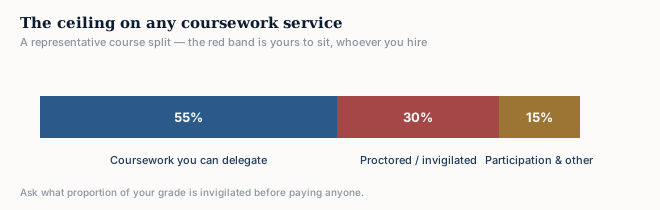
- That the proctored component caps what they can do. If 40% of your grade is invigilated, coursework support has a hard ceiling and you should know where it sits.
- That a perfect score would look wrong on your record. Platforms log timing and attempt patterns. A service aiming at a credible result rather than a maximal one is protecting you.
- That you might be better served elsewhere. Sometimes the answer is free campus tutoring, a withdrawal, or a conversation with your instructor.
A service that agrees to everything, promises an A on every course, and never mentions a limitation has told you exactly how much thought it has given your specific situation.
What a good first conversation sounds like
You can tell most of what you need from the first exchange, before any money moves.
They ask about your assessment structure before quoting. A service that quotes a price without knowing whether your final is proctored is either not thinking or not caring. The weighting determines what is achievable, so it should be the first question, not an afterthought.
They ask where you currently stand. Your existing grade determines what result is both reachable and credible. Nobody who skips this is planning around your actual situation.
They ask what your course conventions are. Citation style, rubrics, whether your instructor has provided sample work. These change the output materially.
They give you a straight answer about limits. Something they will not do should come up unprompted.
They do not pressure you. No countdown, no "one slot left", no discount that expires this evening. Manufactured urgency in a category selling relief from deadline stress is a deliberate and cynical technique.
Conversely: a first message that leads with a price and a payment link, without a single question about your course, tells you the work will be handled with the same amount of thought.
What to check after you have engaged someone
Diligence does not stop at the point of payment.
- Read what is submitted on your behalf. You may be asked about it. Work you cannot discuss is a liability regardless of its quality.
- Watch the gradebook yourself. Do not rely on being told. Untick the graded-only filter periodically so you see the real number.
- Keep your own records. Quote, scope, deadlines, correspondence. If a guarantee claim becomes necessary, this is the evidence.
- Check submission timing. Work submitted minutes before a deadline every single week is a pattern; so is a run of perfect scores after a mediocre term.
- Change your password when the engagement ends. Non-negotiable, whoever you used.
Where we would not be your best choice
A comparison guide that concluded "choose us" for everyone would not be worth reading. Situations where we are the wrong call:
You want someone to sit a proctored exam. We will not, at any price. If that is the requirement, we are not your service — and we would ask you to weigh what you are actually exposing yourself to.
Independent reviews are your deciding factor. The business has run since 2019, but this website is new and there is no third-party review presence yet. An established competitor beats us on that specific criterion today.
You need a guaranteed A. We commit to a realistic band. If a guaranteed top grade is the requirement, someone will promise it — and the promise is the product, not the outcome.
Your work is non-US. Our depth is US institutions and conventions. We take other work selectively.
You need instant 24/7 live chat. We reply in about two hours in US business hours. Some competitors staff round-the-clock chat.
None of this is modesty for its own sake. A student who picks a service for the wrong reason ends up disappointed, and we would rather that happened before payment than after.