
Online class help near me — what “near” actually means online
People search this expecting a local tutor. For online coursework, proximity is the wrong variable — and the things that genuinely do matter locally are your time zone, your institution's calendar and its academic policy. Here is the honest version.
Distance is not the constraint. Time zone is.
We are based in Indianapolis, Indiana, and we support students across all fifty states. If you are searching for someone nearby to sit with you in person, that is tutoring, and your campus almost certainly provides it free — start there before paying anyone.
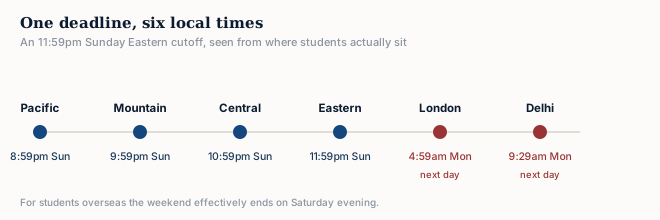
What actually causes problems in online study is not distance. It is the three-hour gap between where you live and where your institution sets its deadlines. An 11:59pm Sunday cutoff in Eastern Time has already passed for a student in Los Angeles who planned to finish Sunday evening, and it lands at 9:29am Monday for a student in India studying with a US university. We convert every deadline into your local time at the start of an engagement, because this single error costs more marks in online study than almost anything else.
Working across US time zones
| Your zone | Common institutional zone | What it changes |
|---|---|---|
| Pacific (PT) | Eastern or Central | Deadlines land up to 3 hours earlier than they read. The most frequent source of "submitted on time" disputes. |
| Mountain (MT) | Eastern or Central | 1–2 hour compression, plus Arizona not observing DST. |
| Central (CT) | Eastern | 1 hour. Small, and enough to lose a Sunday-night quiz window. |
| Eastern (ET) | Eastern | Usually aligned. Check anyway — some programmes run on the founding campus's zone. |
| Alaska / Hawaii | Eastern | 4–6 hours. Sunday deadlines effectively fall on Sunday afternoon. |
| Overseas / deployed | Varies | Largest gap. Worth putting every deadline in a calendar in local time on day one. |
What genuinely is local about your course
Your institution's academic calendar. An eight-week term at SNHU, a 7.5-week session at ASU, a five-week block at Phoenix and a twelve-week FlexPath session at Capella all behave differently. We work to your school's calendar, not a generic semester.
Your institution's policy. Handbooks differ substantially on what is permitted. Yours governs, not ours.
Your proctoring arrangements. Some programmes require an in-person testing centre. Those sittings are yours — we do not sit invigilated assessments anywhere, for anyone.
We publish pages for the institutions we see most: SNHU, ASU, University of Phoenix, Capella, WGU and Liberty.
Reaching a real person
Andrea Falcon, RN founded this service in 2019 and it operates from a real address with a real phone number — 3815 River Crossing, Indianapolis, IN 46240, (765) 688-5315. If "near me" for you means "a company I can actually telephone", that part is straightforward.
Converting a deadline correctly, once
This is the most valuable five minutes of any online course and almost nobody spends it.
Find your institution's stated time zone — it is in the syllabus or the LMS account settings, and it is not necessarily where you live or even where the campus is. Some programmes run on the founding campus's zone regardless of where the student sits. Then convert every recurring deadline once, write the local times down, and work from your own list rather than the platform display.
| Institution deadline | Pacific | Mountain | Central | Hawaii |
|---|---|---|---|---|
| 11:59pm Sun (Eastern) | 8:59pm Sun | 9:59pm Sun | 10:59pm Sun | 5:59pm Sun |
| 11:59pm Sun (Central) | 9:59pm Sun | 10:59pm Sun | 11:59pm Sun | 6:59pm Sun |
| 8:00am Mon (Eastern) | 5:00am Mon | 6:00am Mon | 7:00am Mon | 2:00am Mon |
Two further traps. Daylight saving shifts mid-semester in most of the US, and Arizona and Hawaii do not observe it — so a gap that was two hours in September is three in November. And an availability window is not a duration: an exam "available Friday to Sunday, 90 minutes" will often autosubmit at the window close regardless of how much of your own 90 minutes remains. Starting late in the window truncates your time.
Your institution's calendar is the real "local" factor
Term structure varies more than geography does, and it changes what support even looks like.
| Structure | Typical of | What it means for you |
|---|---|---|
| 5–6 week blocks, one course at a time | University of Phoenix | One missed week is 20% of the course and usually unrecoverable. No slack anywhere. |
| 7.5-week sessions | ASU Online | Roughly double the weekly load of a standard semester. Withdrawal deadline arrives fast. |
| 8-week terms, two courses at once | SNHU | Both courses peak in weeks 5 and 7 simultaneously. Predictable and rarely anticipated. |
| 12-week self-paced sessions | Capella FlexPath | No imposed deadlines. Drift is the failure mode, not workload. |
| 6-month subscription terms | WGU | Flat fee, unlimited courses. Pace is money; falling behind is expensive. |
| Standard 15–16 week semester | Most traditional universities | Room to recover from a bad fortnight. The most forgiving structure. |
We keep dedicated pages for the schools we see most often, because the right plan for an eight-week SNHU term is genuinely different from the right plan for a Capella FlexPath session.
Where we actually are, and why it is on the page
MyOnlineClassHelp operates from 3815 River Crossing, Indianapolis, IN 46240, and the phone number is (765) 688-5315. It was founded in 2019 by Andrea Falcon, RN.
We publish this because a substantial part of what people are really asking when they search "near me" is is this a real company or an anonymous website. In a category with a genuine scam problem, the absence of an address and a phone number is information. Most competitors in this space publish neither.
What proximity does not give you: we are not going to meet you on campus, and we would not claim to have a local office in your city when we do not. Services listing a dozen city addresses in this industry are almost always listing virtual mailboxes.
Who we work with across the country
Students in all fifty states, in the same handful of situations regardless of where they live.
Working adults on accelerated online programmes. The largest group, and the one where geography matters least and calendar matters most.
Nursing and allied health students during clinical semesters. Twelve-hour clinical days plus theory coursework plus care plans. The constraint is hours in the week, and it is identical in Oregon and in Florida.
Military and deployed students. Often the largest time-zone gaps and the least predictable schedules. Deadline conversion matters most here.
Students in a different country studying with a US institution. Eight to twelve hour offsets, meaning Sunday-night deadlines land Monday morning. This is where the single conversion step pays for itself.
What we will not pretend about local search
If you searched "online class help near me" hoping for someone in your city, the honest answer is that for online coursework there is no advantage to it. A specialist in your subject who is three time zones away is worth considerably more than a generalist ten minutes down the road, because the work happens asynchronously either way.
The exception is genuinely local: if your programme requires an in-person proctored sitting at a testing centre, that is local, it is yours, and no service anywhere — near or far — should be offering to attend it for you.
Your institution's policy is the local rule that matters
Of everything that genuinely varies by where you study, academic policy varies most — and it governs regardless of what any service tells you.
Handbooks differ substantially on what constitutes unauthorised assistance, how collaboration is defined, what happens on a first finding, and whether the process differs for coursework versus examinations. Two students at different institutions doing identical things can face very different outcomes.
What to locate in your own handbook before engaging anyone: the definition of unauthorised assistance; whether it distinguishes practice work from graded assessment; the penalty structure for a first finding; and whether there is an appeal route. This takes fifteen minutes and it is the most consequential fifteen minutes available to you.
Our position does not change by state: routine coursework where your institution permits it; never anything invigilated. Our academic integrity page sets that out in full.
Response times across time zones
The practical question behind "near me" is often just: will someone answer when I need them?
We reply to new requests in about two hours during US business hours, and we do not pretend to be a 24/7 operation with staff on every continent. If you send a request at 3am Eastern, it will be read in the morning. Services advertising instant round-the-clock response are usually describing a chat widget, not a specialist.
Where timing genuinely matters is urgent work. A request with a deadline inside twelve hours is assessed on whether the right specialist is actually free — and if they are not, we say no rather than assigning a generalist. That answer is the same whether you are in Indiana or Guam.
Common questions about location
Do you have an office in my city? No. One address, Indianapolis, and we are not going to list virtual mailboxes in thirty cities to appear local. Several competitors do; the addresses are not staffed.
Does it matter that you are not in my state? For online coursework, no. Your course runs on a platform your institution hosts; subject expertise and deadline discipline determine the result, not distance.
Can you work with my international university? Our depth is in US institutions and US conventions — APA, MLA, US grading structures, US LMS platforms. We take non-US work selectively and will tell you plainly if we are not the right fit.
Can someone attend my in-person exam? No. Not in Indianapolis, not anywhere, not for anyone. That refusal is the whole reason to trust the rest of what is on this site.
Do you work weekends? Yes for delivery on agreed deadlines. New enquiries at 2am Sunday get answered Sunday morning.
Time zone habits that prevent most lost marks
Four habits, all free, that between them prevent the large majority of avoidable deadline losses in online study.
Put every deadline in your own calendar in your own time zone. Not the LMS calendar — your phone. The LMS calendar shows due dates but not availability closes, and those two behave completely differently: a passed due date usually still accepts late work, a passed availability close accepts nothing at all.
Set notifications to immediate rather than digest. Most platforms default to a daily or weekly summary, which means a grade posted with instructor feedback on Tuesday may not reach you until Friday. Changing this takes one minute in account settings and removes an entire class of surprises.
Treat your personal deadline as several hours before the real one. Not for discipline — for the technical failures that actually happen. Uploads fail, file types get rejected, connections drop mid-quiz. A buffer converts those from disasters into inconveniences.
Never start a timed assessment near the end of its window. If the window closes at midnight and the exam allows ninety minutes, starting at 11:15 gives you forty-five, because many platforms autosubmit at the window close regardless of your personal clock.
The honest summary of "near me"
For online coursework, geography is close to irrelevant and three other things are not: what time zone your deadlines are set in, what calendar structure your programme runs, and what your institution's policy permits. Those are the variables that decide outcomes, and none of them is solved by finding someone in your city.
What a real address and a working phone number do tell you is that there is a company behind the website with somewhere to be reached. In this category that is worth more than proximity, and it is the reason ours are published on every page rather than buried.
What we cover, wherever you are
The service is the same in every state. Whole-course management for students who need the recurring load carried; individual assignments written to your rubric and citation style; weekly homework on publisher platforms; discussion posts and replies written to the board's own rubric; quizzes where they are unproctored and your institution permits it; and long-form projects including capstones and portfolios.
Subject depth is strongest in nursing and health sciences, statistics, accounting, mathematics, economics and computer science. Platform-specific handling for Canvas, Blackboard, ALEKS, MyLab and Connect.
Pricing starts at $37 a week and every engagement is quoted as one fixed all-in figure before anything begins — see pricing for how that is calculated, or the case studies for what the work looks like in practice.
Deployed, overseas and non-traditional students
Two groups have the hardest version of the time-zone problem, and both are common in US online education.
Active-duty and deployed students. Online degrees are heavily used across the services, and the difficulties are specific: unpredictable duty schedules, deployments that make a fixed weekly rhythm impossible, connectivity that is not guaranteed, and time-zone offsets of eight to twelve hours. Many institutions have military student services with genuine flexibility on deadlines and deferrals — that office is worth contacting before anything goes wrong rather than after, because accommodations are far easier to arrange in advance.
Students living abroad on US programmes. An 11:59pm Sunday Eastern deadline is 9:29am Monday in India, 4:59am Monday in London, and 1:59pm Monday in Sydney. The practical effect is that "the weekend" for coursework purposes ends on Saturday evening local time. Students who work this out in week one lose nothing to it; students who work it out in week four have usually lost two assignments already.
For both groups, the single conversion exercise described above is worth more than any other habit. Everything else in online study is recoverable; a closed availability window is not.
Why an Indianapolis company is on your screen
MyOnlineClassHelp grew out of one nurse's practice, not a marketing operation. Andrea Falcon started it in 2019 working with students she recognised from her own training, and for most of seven years it ran entirely on word of mouth — one student telling another, one cohort telling the next.
That model reaches people who happen to know someone. This website exists to reach the ones who do not, which is why you are reading a page about a search term rather than being handed a phone number by a classmate. The work itself has not changed: an in-house team, matched by subject, with a published position on what will and will not be done.
If you want to know what that looks like in practice rather than in marketing copy, the case studies set out four real situations including the arithmetic, and the reviews page publishes all 36 reviews we have collected, critical ones included.