
Online tutoring vs online class help — what actually differs
These are treated as interchangeable and they are not. They cost different amounts, they carry different risks, and one of them is what you want considerably more often than people assume. Here is the distinction set out plainly, including where each one is the wrong choice.
The difference at a glance
| Online tutoring | Online class help | |
|---|---|---|
| What you get | Someone teaches you the material | Someone carries the coursework |
| Your time commitment | High — you do the work, with guidance | Low on routine work; still yours on invigilated assessment |
| Typical cost | $30–$80 per hour, ongoing | Fixed per task or per course |
| Best when | You have time and a specific gap in understanding | You have understanding and no time, or you are behind and out of runway |
| Worst when | You are four weeks behind with eleven deadlines | The exam is proctored and worth most of the grade |
| Institutional view | Almost universally permitted, often provided free | Varies by institution; depends on the assessment and the policy |
| What it leaves you with | The knowledge | The grade, and the time to get the knowledge elsewhere |
When tutoring is the better answer — and we will say so
If you have four or more weeks, a manageable deadline load, and one specific concept that is blocking you, tutoring is genuinely the better purchase. It is cheaper over a semester, it leaves you able to sit the exam, and it fixes the cause rather than the symptom.
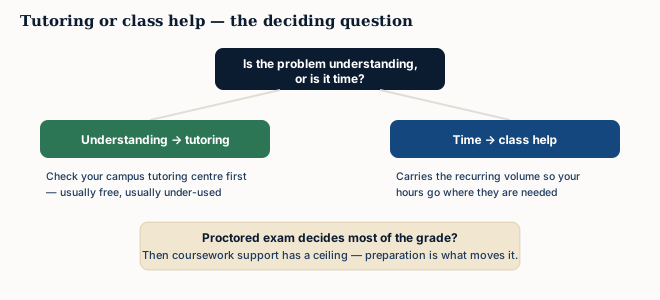
It is also frequently free. Almost every US institution funds a tutoring centre, writing centre and subject-specific help desks, and they are chronically under-used. Before paying anyone — us included — it is worth checking what your tuition already covers. We say this on a page that exists to sell you something because a student who needed tutoring and bought coursework support has wasted their money and still cannot pass the final.
Tutoring is the right call when: the problem is one gateway concept; the course has heavy proctored assessment; you are early in the term; or the subject is a prerequisite for something you will be examined on again later.
When class help is the better answer
Class help fits a different problem, and it is a real one. It is not about capability. The students who come to us are overwhelmingly people whose week does not contain enough hours — nursing students on twelve-hour clinical days, working parents on accelerated eight-week terms, people carrying five courses because financial aid requires full-time enrolment.
Tutoring does not solve that. An hour of tutoring adds an hour of obligation to a week that is already over capacity. When the constraint is time rather than understanding, more instruction is the wrong instrument.
Class help fits when: the routine volume is the problem; you are far enough behind that catching up and keeping up simultaneously is not possible; the course is a requirement outside your field with nothing downstream depending on it; or a specific disruption — illness, a family crisis, a work period — has cost you weeks you cannot recover.
Tutoring buys understanding and costs time. Class help buys time and does not, by itself, buy understanding.
The distinction that actually matters
Google's own AI summaries of this category draw a line between legitimate tutoring and proxy completion, and warn that paying someone to complete graded assessments often breaches honour codes. That warning is fair and we are not going to argue with it.
Where we sit: routine coursework where your institution permits it, always; invigilated assessment, never. Proctored exams, ATI and HESI predictors, licensure-linked testing and anything verified against your identity are yours. We refuse those every week and we lose the sale every time. See our academic integrity position for the full statement.
The practical version: read your syllabus and your student handbook before buying anything from anyone in this category. Policies vary enormously by institution and by assessment type, and a service that tells you not to worry about it is not a service that will be in the room if it goes wrong.
The option nobody sells you
Most of our better engagements are a mix, and it is worth knowing this exists. We carry the recurring volume — discussion posts, weekly problem sets, routine assignments — and spend the freed time working through the exam material with you properly. You keep the grade and you keep the knowledge.
This is the right shape whenever a course has meaningful proctored assessment, because coursework support alone has a hard ceiling there. A student who outsources everything and walks into a 40% proctored final has bought a good coursework grade and a bad outcome.
What each actually costs over a semester
The per-hour figure is misleading in both directions, so it is worth working the arithmetic over a whole course rather than a single session.
| Scenario | Tutoring | Class help |
|---|---|---|
| One difficult concept, 3 sessions | $90–$240 total. Clearly better value. | Not the right instrument — you are buying volume support you do not need. |
| Weekly support, 15-week course | 1 hr/week at $30–$80 = $450–$1,200, and you still do every assignment yourself. | Fixed quote covering the coursework. Often comparable or lower, and the hours come back to you. |
| Four weeks behind, 11 items outstanding | Adds obligation to a week already over capacity. Rarely recovers the position. | What this is for. |
| Course with a 40% proctored final | Directly prepares you for the thing that decides the grade. | Hard ceiling. Coursework support alone cannot reach the mark. |
The honest summary: tutoring is cheaper when the problem is narrow and you have time. Class help is cheaper when the problem is volume, because the alternative is not "study harder" — it is dropping a course and repeating it, which costs a full tuition line and a semester.
And the free option is real. Campus tutoring centres, writing centres, subject help desks, TA office hours and librarian research appointments are all included in tuition you have already paid. They are consistently under-used. If your problem is one concept and you have four weeks, you should exhaust those before paying anyone.
The mistake that wastes the most money
Buying the wrong one. It happens in both directions and it is expensive.
Buying tutoring when the problem is time. A student four weeks behind books weekly tutoring, attends two sessions, misses the third because an assignment was due, and stops. They have paid for instruction while the deadline problem carried on untouched. The tutoring was good; it answered a question they were not asking.
Buying class help when the problem is understanding. A student outsources every assignment in a course with a cumulative proctored final worth 40%. Coursework grade looks excellent through week fourteen. They sit the final having never worked a problem themselves and fail it, and in courses with an exam floor they fail the course outright regardless of the coursework average. This is the more damaging error and it is the one this industry has an incentive not to warn you about.
Both are avoidable with one question asked honestly at the start: is my problem that I do not understand this, or that I do not have time for it? Most people know the answer. It is worth answering before spending anything.
What a mixed engagement looks like in practice
Because most real situations are not purely one or the other, here is how the blend actually runs on a typical course.
Week one: the syllabus gets read properly — component weights, whether an exam floor exists, whether lowest scores are dropped, and which assessments are invigilated. That determines the split. A course that is 70% proctored gets a preparation-weighted plan; a course that is 70% coursework gets a volume-weighted one.
Ongoing: the recurring items that consume evenings without teaching much — discussion posts, routine problem sets, weekly platform homework — get carried. These are the things students lose marks on through attrition rather than difficulty.
Alongside: the material that will be examined gets worked through with you. Solutions are set out as worked examples with the method visible, not bare answers, precisely so they function as revision material.
Before the exam: the format gets drilled, not just the content. If it is multiple choice under time pressure the skill is elimination and pacing; if it is problem-based it is method selection. These are separable skills that respond quickly to practice, and most students revise content while neglecting them.
The result is that you go into the invigilated assessment having spent your available hours on it rather than on discussion board replies. That is the entire logic of the arrangement.
Which one do you need?
A short diagnostic. Answer honestly rather than optimistically.
| If this describes you | You probably need |
|---|---|
| I understand most of it but one topic is blocking everything | Tutoring — likely free at your institution |
| I understand the material and have no hours left in the week | Class help on the routine volume |
| I am several weeks behind and cannot catch up and keep up at once | Class help, with triage on what is unrecoverable |
| My grade is fine but one proctored exam decides it | Tutoring or exam preparation |
| This is a required course outside my field with a light exam weighting | Class help — nothing downstream depends on it |
| This is a prerequisite I will be examined on again next year | A mix, weighted toward retained understanding |
| I failed this once and I am repeating it | Diagnosis first — what specifically failed? Usually neither product until that is answered |
If your row points at tutoring, we will tell you that when you contact us. We would rather lose a sale than take money for the wrong instrument, and a student who buys the wrong thing tells people about it afterwards.
Questions people ask about the difference
Is tutoring always allowed and class help never? No, and that framing is too simple. Tutoring is almost universally permitted. Class help sits on a spectrum that depends entirely on the assessment type and your institution's policy — routine practice work and invigilated examinations are treated very differently in most handbooks. Read yours.
Can I start with one and switch? Frequently the right move. A common pattern is class help through a crisis period to stabilise the grade, then tutoring for the exam material once the deadline pressure has lifted.
Does using class help mean I learn nothing? Only if that is how you use it. Worked solutions with the method shown are usable as study material; a bare answer handed in is not. Which one you get is partly a function of what you ask for.
Which is safer if I am worried about getting caught? Tutoring, unambiguously. If that concern is your primary one, it is telling you something worth listening to about your own institution's policy.
The third option nobody mentions: changing the course, not the coursework
Sometimes neither product is the answer, and a service that never says so is not being straight with you.
Withdrawal. If the arithmetic says the grade you need is unreachable, a W on the transcript is usually better than an F. It carries no GPA impact at most institutions. It has a hard deadline, typically somewhere between week eight and week twelve, and the option disappears without warning. Find that date before spending money on either tutoring or class help.
An incomplete. If your problem was a specific disruption — illness, bereavement, a work crisis — rather than a term-long drift, an incomplete lets you finish later under an agreed deadline. Instructors grant these more readily than students expect, and almost nobody asks.
Talking to the instructor. Free, and consistently the highest-return action available. Instructors can reopen a quiz, accept late work, grant an extension or offer an alternative assignment. That discretion is exercised far more readily for a student who asks in week nine than one who appears in week fifteen.
We raise these because a student who buys twelve weeks of coursework support for a course that was already mathematically lost has wasted money we took. We would rather run the arithmetic first and tell you.
The short version
Tutoring buys understanding and costs time. Class help buys time and does not, by itself, buy understanding. Neither is a substitute for the other, and the expensive mistake in both directions is buying the one that answers a question you were not asking.
If you have time and a specific gap, tutor — and check what your institution already provides free before paying anyone. If you have understanding and no hours, class help fits. If a proctored exam decides most of your grade, no amount of coursework support changes that, and anyone implying otherwise is selling you a ceiling they have not mentioned.
Most real situations sit between the two, which is why our better engagements carry the recurring volume while working the examinable material with you properly.
How the choice changes by subject
The tutoring-versus-class-help decision is not subject-neutral. Some subjects punish outsourcing far more than others, because of how they are assessed.
| Subject area | Typical exam weight | Which fits |
|---|---|---|
| Mathematics, statistics, accounting | High, usually proctored | Tutoring or a mix. Exam questions are homework questions with new numbers, so coursework-only support leaves you exposed. |
| Nursing and health sciences | High, plus an exam floor and standardised predictors | A mix at most. Proctored and licensure-linked assessment is yours, and an exam floor can fail you regardless of coursework. |
| Business, management, marketing | Moderate; often case and project based | Class help fits well. Assessment is largely written deliverables. |
| Humanities, composition | Low; essay and discussion based | Class help fits well, though writing improves only if you read what is produced. |
| Computer science | Varies; often practical exams and code review | Mix. You may be asked to explain your own submission. |
| General-education requirements outside your field | Usually low | Class help. Nothing downstream depends on it. |
The pattern: the more a subject is assessed under invigilation, the more the balance shifts toward tutoring and preparation. The more it is assessed through submitted work, the more class help does what you actually need.
Four things people get wrong about the distinction
"Tutoring is the honest one, class help is the dishonest one." Too simple. Plenty of what is sold as tutoring is a tutor completing the assignment while the student watches, which is class help with extra steps and a higher hourly rate. And plenty of coursework support is genuinely permitted — proofreading, structural feedback, worked examples. The label on the product tells you less than what actually happens inside it.
"Class help means I never have to engage." Not if there is any invigilated assessment, and there almost always is. It also is not true of the work itself: you should read what is submitted for you, because instructors ask, and because a submission you cannot discuss is a liability.
"Tutoring is always cheaper." Per hour, yes. Across a fifteen-week course at an hour a week, frequently not — and that comparison assumes you still have the hours to do every assignment yourself, which is the assumption that fails for the people who reach us.
"I have to choose one." The most common error. Most workable arrangements are a blend, weighted by how much of the grade is invigilated.